
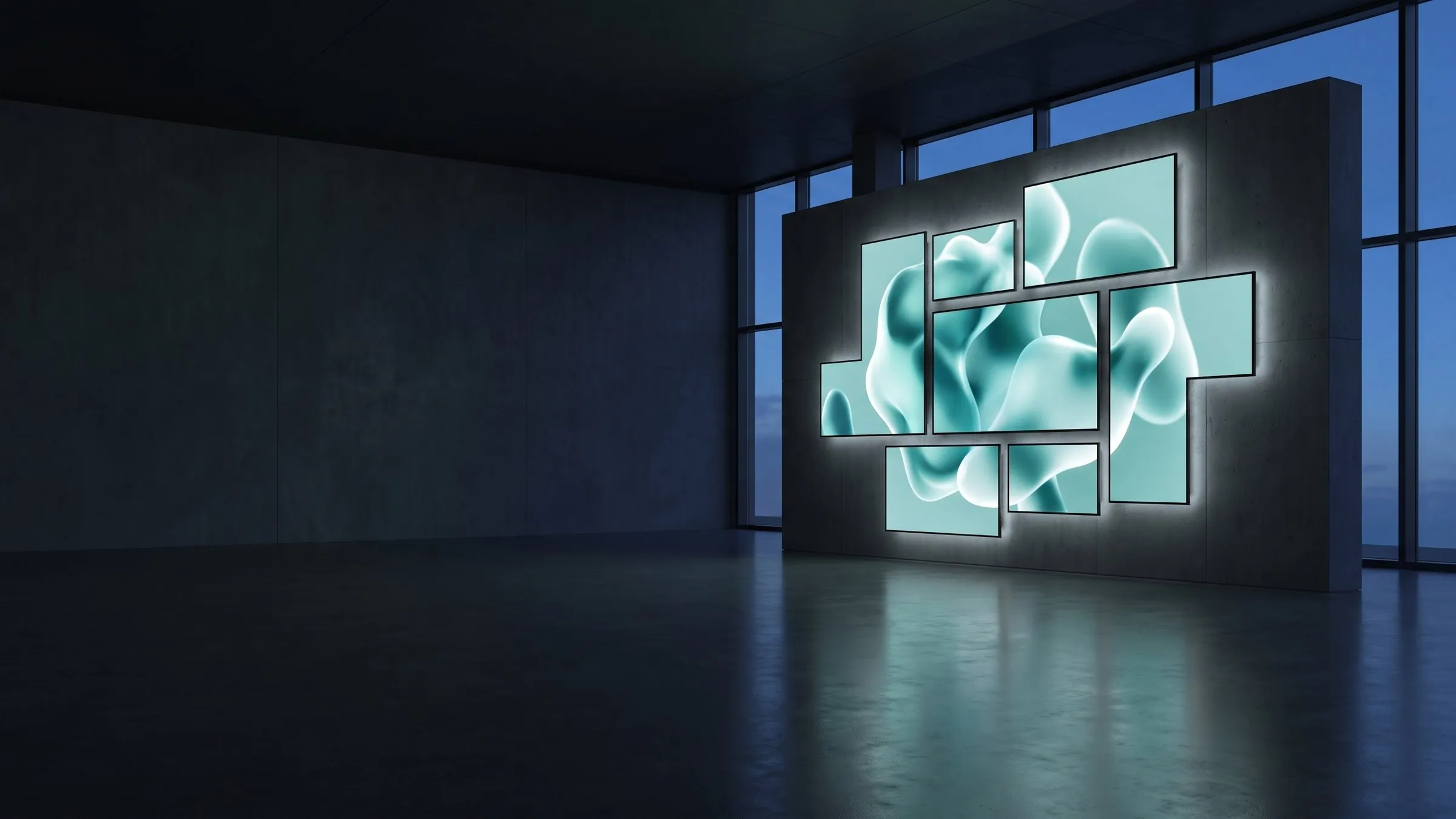
The use case
A brand showroom has a curved wall with seven screens — three landscape panels at the top, four portrait panels below, all offset from each other. The brief calls for a single photographic composition that flows across all seven without cutting at the bezels. A conventional video-wall controller assumes a uniform grid and a single signal split by the hardware; a curved, mixed-orientation arrangement like this requires a different approach.
With viewneo, each screen runs its own viewneo 4K Signagebox, and the Screen Sync plugin distributes the image across all panels over the network. One player acts as the sync master to keep timing aligned. Because the composition is designed in the viewneo CMS as a single canvas mapped to the physical layout, the image sits where it should regardless of panel orientation or bezel position — and each screen still displays at full 4K.
This makes art walls a practical option for retail flagships and brand spaces, hospitality receptions and event venues, and any interior where a conventional grid video wall would look too uniform.
What is in the bundle
- Software: viewneo Enterprise — the CMS where the composition is designed and every screen is managed
- Plugin: Screen Sync — distributes and synchronises content across all panels over the network
- Hardware: one viewneo 4K Signagebox per panel, with one designated as the sync master
How it works
- One player per panel — connect a 4K Signagebox to each screen. Nominate one as the sync master; it keeps timing aligned across the whole installation.
- Design the composition in the CMS — build the canvas in viewneo Enterprise, mapping each panel’s position and orientation. Synced zones share one image; independent zones carry their own content.
- Distribute over the network — Screen Sync pushes the content to each player. There is no video-wall controller, splitter, or scaler between the source and the screen.
How an art wall differs from a regular video wall
A standard video wall uses a uniform grid and a single signal split by a hardware controller. The signal is divided, so the overall resolution is shared across panels. An art wall breaks those constraints in two ways.
First, there is no shared signal. Each player drives its own screen at full 4K, so a seven-panel art wall delivers seven times the pixel density of a single-player splitter setup. Second, the layout is free. Panels can be portrait, landscape, offset, stepped, or arranged in any shape the architecture allows — the composition is mapped in software, not constrained by hardware.
The practical result is that an art wall can be both a high-resolution display and a design object in the room, not just a functional screen cluster. Compare the full range of installation types on the multi-screen installations page.
Get started
Contact a solutions engineer with your screen count, layout sketch, and room dimensions and we will specify the player count and CMS configuration. Book a demo or review pricing to understand the software plan your installation requires.